
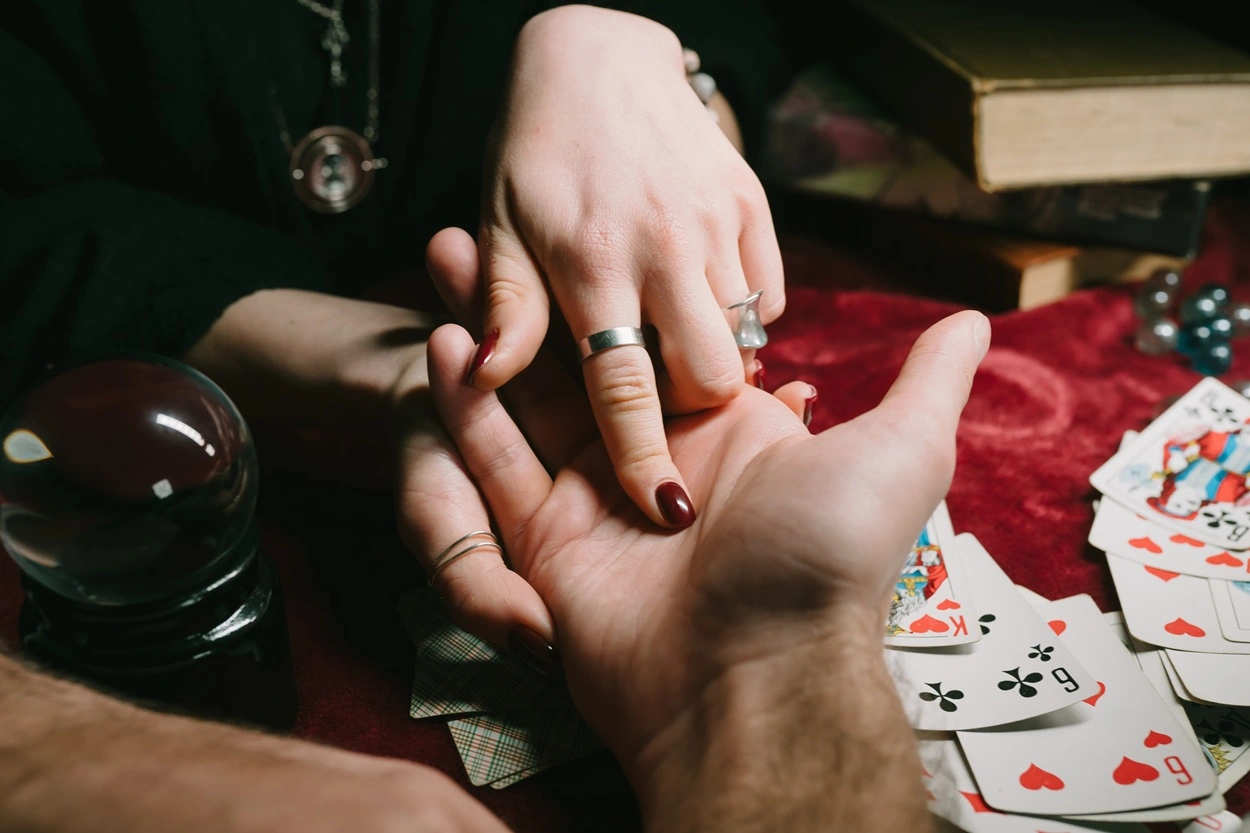
Have you ever looked down at your own palm and wondered what those lines really mean? You’re not alone and the answer runs far deeper than most people realize.
In the Indian tradition, palmistry is known as Hastrekha Shastra, a branch of the ancient science of Samudrik Shastra the study of understanding a person through the physical and subtle characteristics of the body. Legend holds that this knowledge was first revealed by Lord Shiva at the request of Goddess Parvati. And contrary to popular belief, it is far more than simply “reading lines.”
Samudrik Shastra takes in a person’s height, weight, fingers, body structure, gait, laughter, facial features, eyes, ears, lips, teeth, nails, skin, complexion, voice, and temperament, alongside the seven bodily essences (Sapta Sara) and the five elements Agni (Fire), Jala (Water), Prithvi (Earth), Vayu (Air), and Akasha (Ether) that shape a person’s constitution and nature.
It goes even further, into Sattva, mental qualities, psychological expression, gestures, eye contact, behaviour, and traditional concepts tied to past-life impressions and karma. As an astrologer and practitioner of the occult sciences, I don’t approach palmistry as a simple reading of lines. I approach it as a holistic study of who you are — your personality, tendencies, strengths, challenges, and the larger journey your life is on.
Which Hand Should Be Read?
One of the most common questions I hear is: should I show you my left hand or my right?
Traditional Hastrekha Shastra doesn’t give a single answer it depends on several factors: gender, birth time, lunar phase, marital status, age, and independence:
- Someone born in Shukla Paksha (the waxing Moon) is traditionally examined through the left hand; someone born in Krishna Paksha (the waning Moon), through the right.
- For both men and women, the left hand is traditionally significant for night births, and the right hand for day births.
- A financially dependent woman, particularly one dependent on her husband’s income, is traditionally read through the left hand, while an independent, earning woman is read through the right.
- The left hand is also traditionally emphasized for unmarried individuals, ascetics, dependent men, and young children.
Different hands are also traditionally linked to different areas of life mother, father, spouse, family, birthplace, fortune, dharma, comforts, and material circumstances.
In my own practice, however, I prefer to read both hands rather than relying on just one. Your dominant hand reflects your active choices, present circumstances, and the way you are actively shaping your life. Your non-dominant hand reveals your inherent tendencies, natural potential, and deeper patterns you were born with. A truly comprehensive reading comes from comparing both their lines, mounts, shapes, markings, and how they change over time.
The Three Major Lines of the Palm
Every palm reading rests on three foundational lines the Heart Line, Head Line, and Life Line. None of these lines should ever be read in isolation; their length, depth, clarity, direction, breaks, branches, and relationship to one another all matter.
The Heart Line (Hridaya Rekha): Speaks to your emotional and relational world. Traditionally tied to love, affection, attachment, and sensitivity, its formation offers insight into your emotional nature and how you approach relationships.
The Head Line (Mastishka Rekha): Also known as the Mind Line, it reflects how your mind works your intellect, memory, concentration, reasoning, decision-making, imagination, and mental stability. Its relationship to the Life Line and its direction toward the Lunar Mount add further layers of meaning.
The Life Line (Jeevan Rekha): Begins between the thumb and index finger and curves around the Mount of Venus toward the wrist. It’s traditionally tied to physical vitality, stamina, energy, resilience, and the major transitions of your life also known as Kula Rekha in some traditional texts. Importantly, it is not a measurement of how long you will live. Longevity is assessed through a much broader reading of the palm, including other lines, mounts, and markings.
No single line ever tells the whole story. Every line speaks in relation to the others and to the mounts, markings, hand shape, and finger structure that surround it.
Hand Shapes and the Four Elements
The shape of your hand lays the foundation for understanding your basic temperament, traditionally classified according to the four elements:
- Earth Hands — Broad, square, with shorter fingers. Practical, stable, disciplined, and grounded.
- Air Hands — Square or rectangular palms with longer fingers. Intellectual, communicative, curious, and analytical.
- Water Hands — Longer palms with long, slender fingers. Sensitive, intuitive, imaginative, and empathetic.
- Fire Hands — Longer palms with shorter fingers. Enthusiastic, confident, ambitious, and driven to act.
Your hand shape sets the personality framework which is then refined and deepened through the lines, mounts, fingers, nails, and markings unique to you.
Vedic Insight: Auspicious Marks (Shubh Chinh)
Beyond the major lines, traditional Hastrekha Shastra places great importance on Shubh Chinh auspicious marks that appear on the palm, such as a star, trident, lotus, fish, or conch. These symbols are believed to carry deep significance, often pointing to blessings related to fortune, spiritual inclination, protection, or success arriving at a particular stage of life.
A mark near the Mount of Jupiter, for instance, is traditionally associated with leadership and recognition, while one near the Mount of Sun may point toward creative or reputational success. These marks are never read in isolation their meaning is shaped by their placement, clarity, and the surrounding lines and mounts, making an experienced eye essential to interpreting them correctly.
Common Myths About Palmistry
Palmistry carries a lot of misconceptions:
- Myth 1: The Life Line predicts your exact lifespan.
Reality: It speaks to vitality, constitution, energy levels, and major life transitions. - Myth 2: Astrologers should only read one hand.
Reality: A meaningful, accurate reading compares both the dominant and non-dominant hands. - Myth 3: Palmistry is simple fortune-telling.
Reality: It is a holistic study of Samudrik Shastra, analyzing hand shape, mounts, fingers, lines, and physical cues together. - Myth 4: Your palm lines are fixed forever.
Reality: Lines shift and evolve over time as your consciousness, choices, habits, and life path change.
Frequently Asked Questions (FAQs)
1. Which hand should be read?
Traditionally it depends on factors like gender, birth time, and marital status, but a complete reading looks at both hands comparing the dominant hand (your present choices and active path) with the non-dominant hand (your inherent blueprint).
2. Does a short life line mean a short life?
No. This is one of the biggest myths in palmistry. The Life Line reflects vitality, resilience, and major life transitions not the number of years you’ll live. Longevity is assessed through a comprehensive reading of multiple mounts and secondary lines.
3. Can palm lines change?
Yes. Palm lines can shift over time, reflecting your evolving experiences, conscious decisions, mindset, and life circumstances. A reading today can look noticeably different after several years.
4. Left hand vs. right hand for women?
Traditionally, a financially dependent woman is read through the left hand, while an independent, earning woman is read through the right hand. However, examining both hands provides the most complete and accurate insight.
5. Is palmistry scientifically proven?
Palmistry is an ancient observational discipline rooted in Samudrik Shastra. It is best approached as a profound intuitive framework for self-understanding, pattern recognition, and spiritual guidance rather than a clinical science.
Ready to Discover What Your Palm Reveals?
Reading your own palm from an article is one thing having it read by someone trained in the full depth of Hastrekha Shastra is another entirely. If you’re curious about what your lines, mounts, and hand shape reveal about your relationships, career, mind, and life path, I’d love to guide you through a personal reading.
Book your one-on-one palm reading consultation today message me to book your slot and discover what your hands have been trying to tell you all along.
 Gain clarity about your life purpose and soul path.