
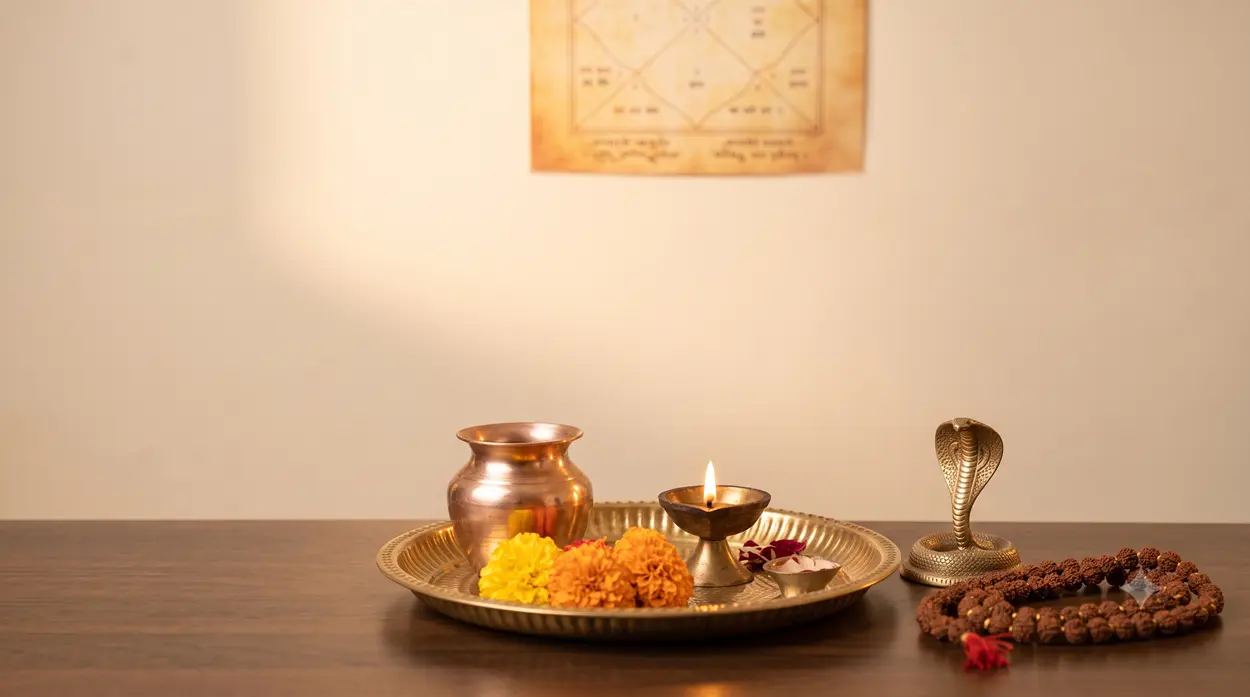
If you’ve ever consulted an astrologer and heard the words “Kaal Sarp Dosh,” you may have felt a flicker of worry. In Vedic astrology, this is one of the most talked-about and most misunderstood planetary configurations. It forms when all seven classical planets (Sun, Moon, Mars, Mercury, Jupiter, Venus, and Saturn) sit enclosed within the axis of Rahu and Ketu, the two shadow points that represent the Moon’s nodes. Rahu symbolizes desire, ambition, and unfinished worldly pursuits; Ketu represents detachment, past-life imprints, and karmic residue. Together, they don’t curse a life, they frame it, marking a soul’s unresolved lessons from lifetimes past. Understood correctly, Kaal Sarp Dosh is less a warning and more an invitation to grow.
How Kaal Sarp Dosh Forms in a Kundli
Every birth chart (Kundli) contains twelve houses, and Rahu and Ketu always sit exactly 180 degrees apart, splitting the chart into two halves. Kaal Sarp Dosh forms when all seven classical planets fall entirely within one half hemmed in between Rahu on one side and Ketu on the other, like a serpent coiling around them. When this happens completely, astrologers call it Purna (Complete) Kaal Sarp Dosh. If even one planet slips outside the axis, it’s typically classified as Anshik (Partial) Kaal Sarp Dosh, considered comparatively milder, though opinions among astrologers vary on how strictly this rule should be applied.
It’s worth remembering that this configuration should never be read in isolation. The dignity of each planet, the houses they occupy, their aspects and conjunctions, and the yogas present elsewhere in the chart all shape how or even whether this dosh actually expresses itself in a person’s life.
The 12 Types of Kaal Sarp Dosh
The classification depends entirely on which house Rahu occupies and which houses the planets are trapped between. Here’s a quick reference:
| Type | Rahu House | Ketu House | Life Area Most Affected |
|---|---|---|---|
| Anant | 1st | 7th | Inner peace, marriage, legal disputes |
| Kulik | 2nd | 8th | Family harmony, finances |
| Vasuki | 3rd | 9th | Siblings, friendships, faith |
| Shankhpal | 4th | 10th | Home, career, parental bonds |
| Padma | 5th | 11th | Children, progeny concerns |
| Mahapadma | 6th | 12th | Health, debts, enemies |
| Takshak | 7th | 1st | Marriage, romantic relationships |
| Karkotak | 8th | 2nd | Sudden setbacks, finances |
| Shankhnaad | 9th | 3rd | Fortune, father, authorities |
| Patak | 10th | 4th | Career, domestic happiness |
| Vishakt | 11th | 5th | Friendships, disputes, health |
| Sheshnag | 12th | 6th | Expenses, hidden challenges, health |
Each type carries its own traditional narrative Anant Kaal Sarp Dosh, for instance, is often linked to restlessness and marital friction, while Padma Kaal Sarp Dosh is associated with delays or worries connected to children. But no two people experience the “same” dosh identically, because the rest of the chart always colors the outcome.
Kaal Sarp Dosh Effects on Life
Broadly, Kaal Sarp Dosh is said to touch relationships, career, health, family stability, and mental peace, though which area feels the pressure most depends on the specific type present in the chart. Some natives report a persistent sense of being “one step behind,” recurring obstacles just as success seems within reach, or a nagging restlessness that’s hard to name. Others notice friction with siblings, disappointment from friends, or a strained connection with a parent.
But this is only half the picture. Many astrologers also observe that Kaal Sarp Dosh natives often possess unusual intensity, drive, and resilience. The very tension created by Rahu and Ketu can push a person toward extraordinary focus, ambition, or spiritual depth once they learn to work with it rather than fear it. The dosh’s true weight is always determined by the strength of the planets involved, the ongoing planetary period (Dasha-Antardasha), and the benefic influences present elsewhere in the Kundli.
Remedies for Kaal Sarp Dosh
Remedies for Kaal Sarp Dosh aren’t about erasing a placement that isn’t how astrology works but about consciously balancing Rahu and Ketu’s energies to ease their more disruptive effects. Traditional practices include:
- Installing a Kaal Sarp Yog Shanti Yantra at home
- Chanting “Om Namah Shivaya” and the Mahamrityunjaya Mantra
- Reciting the specific mantras associated with Rahu and Ketu, along with related donations
- Worshipping Nag Devata and observing Nag Panchami with fasting or prayer
- Performing Shiv Rudrabhishek and offering water to a Peepal tree
- Conducting Pitru Tarpan or Shraddha on Amavasya
- Feeding birds, offering food and water to those in need, and charitable giving
No single remedy suits everyone. The right approach depends on which houses Rahu and Ketu occupy, the strength of the surrounding planets, and the Dasha currently running. This is exactly why a personalized reading rather than a generic ritual tends to bring the most meaningful results.
Kaal Sarp Dosh – Myth vs. Reality: Is It Always Negative?
Here’s where popular belief and classical astrology diverge sharply:
- Myth: Kaal Sarp Dosh guarantees a difficult, unlucky life.
Reality: No single yoga decides an entire destiny. A Kundli is a web of dozens of interacting placements, and strong benefics can significantly soften or even transform this configuration’s effects. - Myth: It causes lifelong suffering.
Reality: Its intensity ebbs and flows with age, Dasha, and transits; some phases will feel heavier, others notably supportive. - Myth: Every person needs the same remedy.
Reality: Remedies work best when tailored to the individual chart.
The bottom line: Kaal Sarp Dosh is a karmic pattern worth understanding, not a sentence worth fearing.
Frequently Asked Questions (FAQs)
1. How do I know if I have Kaal Sarp Dosh?
It’s identified by checking whether all seven classical planets fall within the Rahu-Ketu axis. This requires a full Kundli analysis rather than a quick glance, since the type and strength of the formation matter as much as its presence.
2. Is Kaal Sarp Dosh always harmful?
No. Its real impact depends on planetary strength, house placements, aspects, other yogas, and the Dasha in effect the same dosh can play out very differently from one chart to another.
3. At what age does Kaal Sarp Dosh end?
There’s no fixed age. Its influence is felt in waves, shaped by transits and planetary periods, so some life stages will feel its themes more strongly than others.
4. Can remedies fully cancel Kaal Sarp Dosh?
Remedies help pacify and balance Rahu-Ketu’s energy, but it’s inaccurate to claim any ritual completely erases a birth chart placement. Think of remedies as support, not deletion.
5. Is Kaal Sarp Dosh real, or just superstition?
It’s a recognized concept within Vedic astrology, though interpretations vary among astrologers and it isn’t scientifically validated. For those who follow Jyotish, it’s best approached as a framework for self-understanding not fatalism.
Ready to Know Your Own Chart?
Reading about Kaal Sarp Dosh in general terms is a starting point but every Kundli tells a different story. If you’re curious whether this configuration appears in your chart, and what it specifically means for your relationships, career, or health, a personalized consultation with an experienced astrologer is the best next step. Book your one-on-one Kundli reading today and turn uncertainty into clarity.
 Gain clarity about your life purpose and soul path.